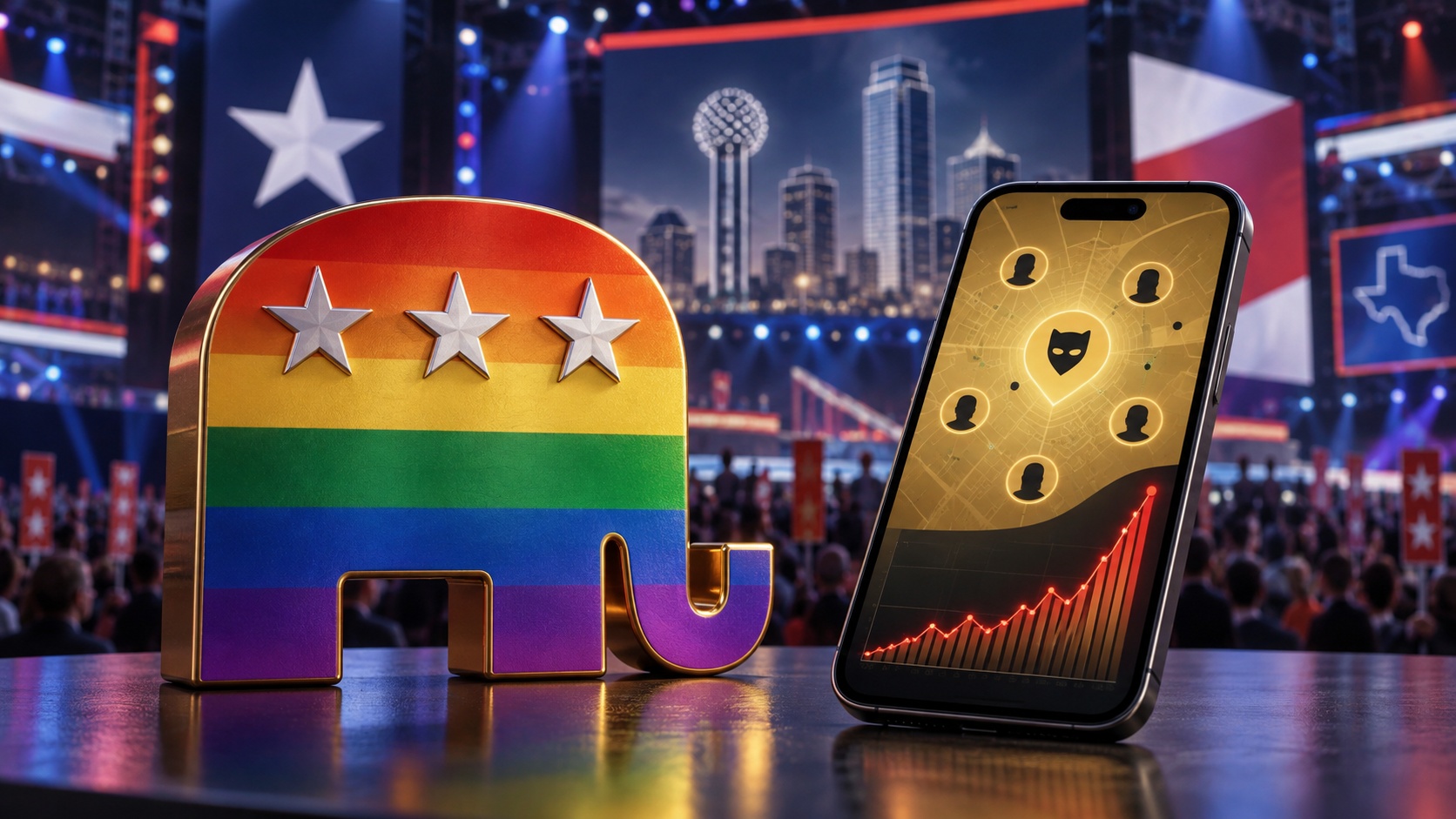
The story practically writes itself. Thousands of Republicans arrive in Dallas for a national convention. Grindr problem reports suddenly rise. The obvious punchline is that closeted Republican men overwhelmed the gay dating app while publicly supporting politicians who oppose LGBTQ rights.
It is funny, politically satisfying and based on a real screenshot. It is also several steps ahead of what the available evidence can prove.
Grindr did not record an outage during the Republican National Committee’s September 2026 convention in Dallas. The company explicitly denied that an RNC-related outage occurred. A third-party service did receive an unusual number of user-submitted problem reports, and Dallas appeared prominently on its map, but those reports cannot tell us whether Grindr’s systems failed, why individual users experienced problems or whether the users were Republican convention attendees.
Historical evidence makes the story more complicated. Grindr really did experience increased activity around the 2016 and 2024 Republican conventions. However, increased usage is not the same thing as a crash. Being near a convention is not proof of attending it. Using Grindr is not proof of being closeted, anti-gay or politically hypocritical.
The best-supported conclusion is that the viral story combined a potentially real signal with conclusions the data was never capable of establishing.
Quick Verdict
| Claim | Verdict |
|---|---|
| People reported unusually numerous Grindr problems during the Dallas RNC convention | True |
| Grindr confirmed a platform outage | False |
| RNC traffic crashed Grindr | Unsupported |
| Grindr activity increased around previous political conventions | True |
| The additional users were Republican delegates | Unknown |
| They were closeted Republicans who publicly opposed gay rights | Unsupported |
The claim that “the RNC crashed Grindr” is therefore misleading at best. The available evidence shows a rise in public problem reports, not a confirmed crash caused by Republican attendees.
How Outage Reports Became “Republicans Crashed Grindr”
The 2026 version of the story began with a social-media post claiming that Grindr outage reports were surging in Dallas on the first day of the Republican midterm convention. The post included information from Downdetector, a popular website that collects reports from people who say they are having trouble with an online service.
The original wording was already more limited than many people realized. It said that outage reports were increasing. It did not establish that Grindr had confirmed an outage or that Republican delegates caused one.
That distinction quickly disappeared as the claim spread. Political commentators and meme accounts shared the screenshot. Former congressman George Santos joined in. The story reached news outlets and eventually late-night television. Jimmy Kimmel told viewers that Grindr “had outages in Dallas,” connecting the claim to similar stories from earlier Republican conventions.
The information had undergone a series of transformations:
- People submitted more problem reports than usual.
- Those reports became a confirmed Grindr outage.
- The timing of the reports became proof that the RNC caused the outage.
- Proximity to the convention became proof that the users were Republicans.
- Grindr use became proof that those Republicans were closeted hypocrites.
Every step added a conclusion that was not contained in the original evidence.
The San Antonio Current offers a useful example. Its headline declared that Grindr was experiencing Dallas outages, but the supporting evidence consisted primarily of Downdetector information, a map and social-media reactions. The article even acknowledged that critics suspected people might be submitting reports to stir controversy. It nevertheless presented the outage itself as an established fact.
The Viral Claim Combines Four Different Questions
To evaluate the story properly, we have to separate four questions that are frequently treated as one.
Did some people experience problems using Grindr?
Probably.
Snopes reported that Downdetector recorded a peak of approximately 460 Grindr problem reports at around 8:49 p.m. on September 9. Dallas also appeared as a significant location on Downdetector’s map.
Some of those reports may have represented genuine user experiences. A person can have trouble loading an app, sending a message or seeing nearby profiles even when the service remains available to most other users.
Did Grindr experience a confirmed platform outage?
The strongest available evidence says no.
Grindr’s official system status page recorded no incident on September 9 or September 10. The company also responded directly to questions from fact-checkers.
“While these rumors are common, the claim is false,” a Grindr spokesperson told Lead Stories. The spokesperson said Grindr had not experienced outages connected to Republican conventions or other large events.
That does not prove that every Grindr user in Dallas had a flawless experience. A short, localized or carrier-specific problem might not result in a declared company incident. However, the company’s internal status reporting and its explicit denial weigh strongly against the claim that convention traffic crashed the Grindr platform.
Did RNC-related activity cause the problem reports?
That remains unknown.
The reports occurred while the convention was taking place, but two events occurring at the same time does not establish that one caused the other. Possible explanations include:
- A limited Grindr problem that did not become a platform-wide outage
- Congested cellular or Wi-Fi service around a crowded arena
- Account, device or connection problems affecting individual users
- People checking the app because they had seen the Grindr rumor
- Joke or politically motivated submissions to Downdetector
- A combination of genuine problems and attention-driven reporting
D Magazine noted that a crowded event can overload local cellular service and make an app appear unavailable even when the app’s own systems are operating normally.
Were the users closeted, anti-gay Republican delegates?
Nothing in the available data can answer that question.
Downdetector does not identify convention delegates. Grindr’s public status page does not reveal its users. A location heatmap does not disclose a person’s political affiliation, sexual orientation, public identity or policy beliefs.
That means the most politically explosive part of the story is also the part with the least evidentiary support.
What Downdetector Actually Measures
Downdetector is useful, but it is frequently misunderstood.
The service collects reports from users and other public sources, then compares the report volume with a normal baseline. If the volume rises significantly above that baseline, Downdetector can indicate that a problem may be occurring.
It does not independently inspect Grindr’s servers or determine why an app is not working for a particular person. Downdetector itself describes different levels of confidence, ranging from possible problems to stronger evidence of an incident. Its data is best understood as an early warning signal, not a technical diagnosis.
A tiny baseline can produce a frightening graph
According to Lead Stories, Grindr’s normal Downdetector baseline was between zero and one report. That matters because a relatively small number of submissions can create an enormous percentage increase.
If reports rise from one to 101, that is a 10,000 percent increase. The percentage looks catastrophic even though the raw increase is 100 reports.
This does not make those reports fake. It means the percentage and the shape of the graph can appear much more dramatic than the underlying number warrants.
The national report count was not a Dallas attendee count
The widely circulated information also mixed two different Downdetector features.
The problem graph represented reports collected nationally. A separate map showed where reports were concentrated, with Dallas appearing as a leading location. The reported peak of approximately 460 was not a verified count of 460 Dallas users, much less 460 people inside the convention.
The map also cannot establish that a person was inside American Airlines Center. At most, it indicates where reports appeared to be concentrated.
A report is not the same as an affected customer
A Downdetector submission cannot tell us:
- How many Grindr users were actually affected
- Whether the problem originated with Grindr
- Whether the submitter was physically at the convention
- Whether the submitter was a Republican
- Whether the person was gay, bisexual, closeted or openly LGBTQ
- Whether the report was serious, mistaken or submitted as a joke
Downdetector limits how frequently repeated submissions from the same source contribute to its public totals, but it does not interview each reporter or verify the reporter’s political identity.
The Story Can Help Create the Data Used to Support It
The Grindr claim has another problem: public attention can affect the measurement itself.
Once people begin posting that Grindr is crashing at the RNC, curious users open Grindr to see what is happening. More people visit Downdetector. Genuine users who experience a delay may submit a report because the rumor primed them to interpret the delay as an outage. Other people may submit reports because they want the joke to be true.
The additional reports create a more dramatic graph. The graph then produces more social-media posts, which send more people to both Grindr and Downdetector.
This is an observation-feedback loop. It does not require a coordinated political operation. It only requires a publicly accessible reporting system and a claim entertaining enough to attract attention.
Could activists have deliberately inflated the reports? It is technically possible. The Grindr-RNC joke was circulating before the Dallas convention, and people understood what a rising Downdetector graph would imply. However, there is currently no evidence of an organized campaign, bot network or coordinated effort to manipulate the data.
The reporting mechanism was potentially gameable. That is not proof that someone actually organized an operation to game it.
Milwaukee 2024: A Real Spike, but Not a Crash
The Dallas story gained credibility because it resembled reports from the 2024 Republican National Convention in Milwaukee.
At the time, media outlets reported that more than 1,000 people had submitted Grindr problem reports through Downdetector. A local Grindr user also told the Milwaukee Journal Sentinel that he saw far more anonymous or faceless profiles than usual.
Grindr’s official tracker, however, showed no operational incident during the convention.
In 2025, Grindr CEO George Arison finally addressed the Milwaukee story directly. He told UnHerd that there had been a “definite” and “significant” increase in usage during the convention.
He also said Grindr “didn’t actually crash.”
Both statements can be true. More people can use an app without knocking it offline. This is the distinction that disappeared as the story was repeated from one convention to the next.
The anonymous-profile anecdote proves very little
One Milwaukee user reportedly said he usually encountered approximately 10 blank or faceless profiles but stopped counting after seeing 50 during the RNC.
That anecdote is interesting, but it is not a controlled measurement.
- It came from one unnamed observer.
- There was no preserved daily baseline.
- Blank profiles were already common on Grindr.
- A blank profile does not prove that its owner is closeted.
- It does not reveal political affiliation or convention attendance.
Some could have belonged to Republican visitors. Others could have belonged to local residents, journalists, protesters, contractors, security personnel, escorts or people exploring the app because the story was trending.
Be cautious with the supposed 166 percent increase
Some recent articles state that Milwaukee Grindr activity increased by 166 percent. That figure is not clearly supported by the CEO’s statement or a publicly available Grindr dataset.
It may reflect a mutation of the verified 2016 finding that Cleveland usage rose by 66 percent, which would place usage at 166 percent of the earlier level. An increase to 166 percent of baseline is not the same as an increase of 166 percent.
Until an original Milwaukee source or dataset can be produced, the 166 percent claim should not be treated as established fact.
Cleveland 2016: The Strongest Evidence of a Convention-Related Increase
The 2016 Republican National Convention produced the most detailed data in the Grindr-RNC story.
According to information Grindr provided to VICE:
- Users online within five miles of Quicken Loans Arena increased 120 percent on the Sunday when convention check-in began.
- Usage near the arena was 66 percent higher during the RNC.
- More than 1,000 men used Grindr near the arena.
- Forty-four percent of the Grindr users in the area were classified as visitors to Cleveland.
- Visiting users were disproportionately white.
- Common profile words included “visiting” and “fun.”
- Twenty-seven profiles mentioned the RNC.
- Six mentioned Trump.
This is meaningful evidence. It strongly suggests that the convention contributed to increased local Grindr activity. Some RNC attendees probably were using Grindr.
It still does not tell us how many of those users were credentialed delegates, Republican voters or people who publicly opposed gay rights.
The “Five Percent of RNC Attendees” Calculation Does Not Work
VICE noted that more than 1,000 Grindr users appeared near the arena while approximately 20,000 people attended the RNC. It then suggested that about five percent of convention attendees used Grindr.
That calculation divides one population by a different population.
The numerator included everyone using Grindr within a five-mile radius. The denominator included estimated convention attendees. Many people in the numerator were never part of the denominator.
The five-mile area could include:
- Cleveland residents
- Hotel and restaurant employees
- Journalists
- Police and private security
- Protesters and activists
- Escorts
- Nonpolitical visitors
- People passing through downtown
Even the visitor designation does not solve the problem. A visitor to Cleveland was not necessarily an RNC attendee.
This is a denominator error and a version of the ecological fallacy. Aggregate activity in a geographic area cannot establish the identity or behavior of every group gathered within that area.
The calculation does not prove that five percent of RNC attendees used Grindr.
The 2016 Democratic Convention Had an Even Larger Increase
Grindr also supplied data from the 2016 Democratic National Convention in Philadelphia.
From Sunday to Monday, Grindr activity near the Wells Fargo Center increased 148 percent. Fifty-seven percent of the nearby Grindr users were classified as visitors.
The time periods were not identical, so the RNC and DNC figures are not a perfect partisan experiment. Still, the Democratic convention’s larger increase demonstrates that Grindr spikes were not exclusive to Republican events.
That comparison substantially changes the interpretation. A large political convention brings thousands of travelers into a concentrated hotel and nightlife district. Some of those travelers are gay or bisexual. Many are away from their partners or usual social circles. Dating and hookup-app activity may consequently increase regardless of political party.
The Republican version became the lasting meme because its perceived hypocrisy supplied a better punchline.
Dating-App Activity Increases at Large Gatherings
Evidence from other dating apps supports the more ordinary explanation.
During the 2016 Conservative Political Action Conference, Tinder usage reportedly increased 230 percent compared with the preceding weekend. Matches increased approximately 1,700 percent, according to GQ’s reporting from CPAC.
That does not prove anything about Grindr’s Dallas traffic. It shows that when a large number of traveling adults gather for a multiday event, dating-app activity can surge. Conferences combine hotels, receptions, parties, unfamiliar people and temporary freedom from normal routines.
Gay and bisexual attendees participate in that behavior just as heterosexual attendees do.
Who Might Appear on Grindr Near an RNC Convention?
The viral interpretation assumes that a Grindr user near the RNC must be a closeted Republican delegate. The real population is much broader.
Potential users include:
- Openly gay Republican attendees
- Closeted Republican attendees
- Bisexual attendees
- Local Grindr users
- Journalists and social-media creators
- Protesters and opposition researchers
- RNC employees and contractors
- Law-enforcement and security personnel
- Escorts who traveled to a major event
- Other tourists and business travelers
- Curious people checking the app because the rumor was trending
The existence of openly gay conservatives alone breaks the viral equation. A Republican using Grindr is not automatically closeted. A gay conservative may support some Republican policies while opposing others. Using a dating app reveals nothing about that person’s position on same-sex marriage, transgender policy or any specific speaker at the convention.
Even a blank profile does not prove secrecy in the politically meaningful sense. People omit photographs from dating profiles for many reasons, including professional privacy, relationship status, safety concerns and a desire to avoid public identification.
Does This Mean There Are No Closeted or Hypocritical Republicans?
Of course not.
There are documented cases of politicians whose private same-sex behavior conflicted with their public positions. Conservative religious and social environments can also create strong pressure to remain closeted.
It is entirely plausible that some RNC attendees privately sought men while supporting politicians or policies hostile to LGBTQ rights. Some might even have been personally responsible for promoting those policies.
But plausibility is not evidence about a specific anonymous population.
“Some hypocritical Republicans probably use Grindr” and “closeted anti-gay Republicans crashed Grindr during the RNC” are different claims. The first is a reasonable general observation. The second requires evidence of a crash, evidence that RNC traffic caused it and evidence about the identities and public positions of the users.
None of those requirements has been met for Dallas.
Why the Grindr-RNC Story Keeps Returning
The rumor survives because it contains a fragment of truth.
Grindr activity has increased around previous conventions. Some Republican attendees undoubtedly are gay or bisexual. Some may be closeted. The party has supported policies that many LGBTQ people consider hostile or discriminatory.
Those facts make the larger story feel true before its individual claims are examined.
The rumor also benefits from source laundering. A social-media account cites Downdetector. A news article cites the social-media account. Another outlet cites the first article. A television host repeats the story as established history. During the next convention, people cite the television segment and the collection of articles as multiple independent confirmations.
In reality, many versions may trace back to the same crowdsourced graph and the same anonymous anecdote.
What Evidence Would Actually Be Needed?
To prove that an RNC convention crashed Grindr, an investigator would need more than a Downdetector screenshot.
Useful evidence would include:
- Grindr’s internal error rates, latency and failed-request data during the alleged outage.
- Unique-user and session data for a clearly defined Dallas area.
- Comparable data from matching weekdays before and after the convention.
- Separation of Dallas reports from the national Downdetector total.
- Cellular-carrier performance near American Airlines Center.
- Comparisons with Democratic conventions and similarly sized nonpolitical events.
- An anonymous, voluntary survey establishing actual convention attendance.
- Evidence connecting individual users’ public political advocacy with contradictory private conduct.
Even then, responsible reporting would need to protect users from being identified or involuntarily outed.
What We Can Actually Conclude
People submitted an unusual number of Grindr problem reports during the 2026 Republican convention in Dallas. Dallas appeared prominently on Downdetector’s map. Some people may have genuinely experienced difficulty using the app.
Grindr did not record a platform incident and explicitly denied that a convention-related outage occurred. Downdetector could not determine the cause of the reports or identify the people submitting them.
Historical data confirms that Grindr activity increased around the 2016 Cleveland RNC and the 2024 Milwaukee RNC. It also increased even more sharply around the 2016 Democratic convention. These patterns support the unsurprising conclusion that dating-app activity can rise when thousands of travelers gather for a major event.
Some Republican convention attendees probably used Grindr. Some may have been closeted, and some may have held hypocritical political positions. The data does not show how many, who they were or what they believed.
The story works perfectly as a joke because it confirms what its audience already suspects. As a factual claim, however, “the RNC crashed Grindr” requires proof of an outage, proof of causation and proof about the users involved.
The available evidence provides none of the three.